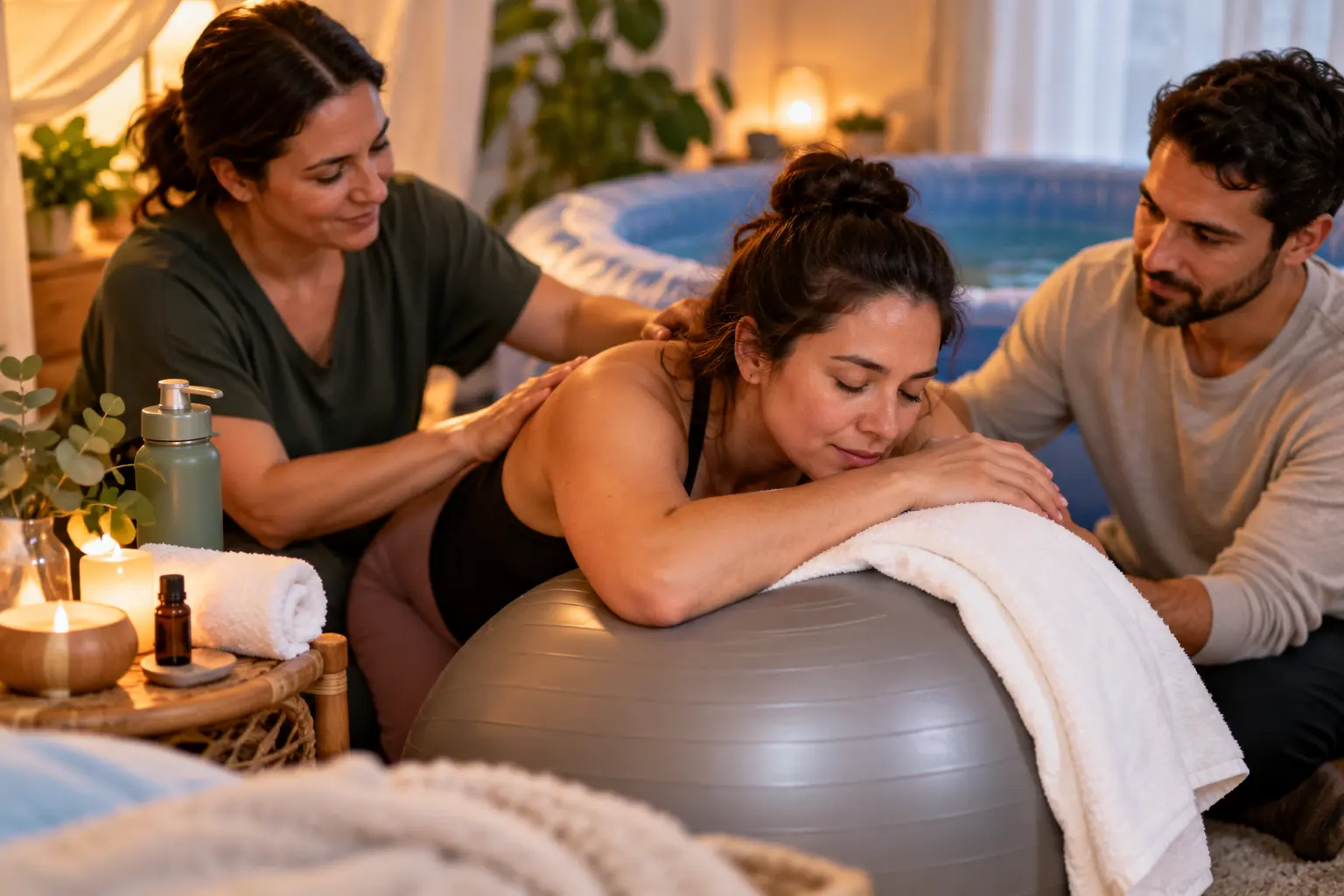
Pain Relief Options at a Home Birth
Pain relief at a planned home birth centers on comfort measures: continuous support, movement and position changes, breathing and relaxation, massage and warmth, and water such as a shower, bath, or birth pool. Medication-based pain relief is more limited at home and depends on your midwife's practice, and an epidural requires a hospital, so if you want one, your plan includes moving to the hospital. Knowing what's realistically available before labor helps you choose a midwife, plan your space, and decide in advance how you'd like to handle a change of plans.
Labor pain is different for everyone, and so is what helps. Some people find that comfort measures are enough. Others decide during labor that they want medication. Both are reasonable, and wanting more pain relief, or transferring to a hospital to get it, is not a failure.
This guide explains each option, what the research says about it, what to ask your midwife, and how to plan for the possibility that you'll want more than home can offer.
Planning a home birth?
Our midwives can talk with you about comfort measures, your preferences, and what pain relief looks like at home.
Comfort Measures vs. Pain Medication
It helps to think of home birth pain relief in two groups:
- Comfort measures (sometimes called nonpharmacologic methods) don't use medication. They include support, movement, relaxation, touch, warmth, water, and devices such as TENS.
- Pain medication (pharmacologic analgesia) includes inhaled nitrous oxide, opioid medications, and epidurals.
A Cochrane overview of labor pain research concluded that most comfort measures "are non-invasive and appear to be safe for mother and baby, however, their efficacy is unclear," because high-quality trials are limited. It found more evidence for medications, which also have more side effects, and emphasized tailoring pain relief to "each woman's wishes, needs and circumstances."
| Option | Type | What the research suggests | At a New York home birth |
|---|---|---|---|
| Continuous support | Comfort measure | Linked to less use of pain medication; no evidence of harm | From your midwife, birth team, and loved ones; a doula can add support |
| Movement and upright positions | Comfort measure | Linked to shorter first stage and less epidural use | Available |
| Breathing and relaxation | Comfort measure | May help; low-quality evidence | Available |
| Massage and warm packs | Comfort measure | May help; low to very low quality evidence | Available |
| Water (shower, bath, birth pool) | Comfort measure | Laboring in water may reduce epidural use | Usually available; ask about pools |
| TENS | Device | Limited evidence of benefit | You'd bring your own; ask your midwife |
| Nitrous oxide | Medication | Reduces pain for many; side effects common | Depends on the practice; ask |
| Opioid medications | Medication | Relieve pain; can cause side effects | Depends on the practice; ask |
| Epidural | Medication | Most effective pain relief | Requires a hospital |
Continuous Support
Having someone with you throughout labor is one of the best-studied comfort measures. A 2017 Cochrane review found that continuous support during labor was associated with less "use of any analgesia" and less use of regional analgesia such as epidurals, along with other benefits. The reviewers "found no evidence of harms of continuous labour support." The World Health Organization (WHO) recommends respectful maternity care that enables continuous support, and states that "a companion of choice is recommended for all women throughout labour and childbirth."
At a home birth, support usually comes from your midwife and birth team, your partner or other loved ones, and, if you choose, a doula.
Movement and Positions
At home, you can move around your own space as you like. A Cochrane review found "clear and important evidence that walking and upright positions in the first stage of labour reduces the duration of labour, the risk of caesarean birth, the need for epidural," though it noted the studies varied and called for better-quality trials. WHO recommends encouraging mobility and an upright position during labor for people at low risk.
Leaning over a birth ball, rocking, walking, kneeling, and side-lying are all options. Our guide to upright birth positions explains what each one may offer.
Breathing, Relaxation, Massage and Warmth
Breathing and relaxation
Slow breathing, muscle relaxation, music, and other relaxation methods are simple to use at home. A Cochrane review found that relaxation, yoga, and music "may have a role with reducing pain," but rated the evidence very low to low quality. WHO recommends relaxation techniques, including breathing, for healthy people who want pain relief in labor, depending on their preferences. Practicing before labor can make these techniques easier to use; childbirth education classes are one way to learn them.
Massage, touch and warm packs
Back massage, counterpressure, and warm packs are common comfort measures. A Cochrane review found that massage, warm packs, and similar methods "may have a role in reducing pain," along with improving people's sense of control, though the evidence ranged from low to very low quality. WHO recommends manual techniques, such as massage or warm packs, for people who want pain relief, depending on their preferences.
Water: Showers, Baths and Birth Pools
Laboring in water
Warm water is one of the most popular comfort measures at home. A 2018 Cochrane review of water immersion found that laboring in water during the first stage of labor "may reduce the use of regional analgesia," such as epidurals. It found "no evidence of increased adverse effects to the fetus/neonate or woman from labouring or giving birth in water." All of the trials took place in hospital labor wards, so none tested water use at home.
The American College of Obstetricians and Gynecologists (ACOG) states that immersion in water during the first stage of labor "may be offered to healthy women with uncomplicated pregnancies between 37 0/7 weeks and 41 6/7 weeks of gestation."
Laboring in water vs. giving birth in water
Laboring in water and giving birth in water are different, and professional guidance differs on the second. ACOG recommends "that birth occur on land, not in water," because it considers the data on the second stage insufficient. The Cochrane review found that the evidence on immersion during the second stage was limited and did not show clear differences in outcomes. If you're considering a water birth, ask your midwife how they approach it and what would lead them to ask you to leave the pool.
Questions about using a birth pool at home
- Do you supply a birth pool, or should we rent or buy one?
- Where can it go in our home, and how will it be filled, kept warm, and emptied?
- When would you ask me to get out of the water?
If you live in an apartment, our guide to home birth in a New York apartment covers practical questions about birth pools in apartment buildings.
TENS
A TENS (transcutaneous electrical nerve stimulation) unit is a small device that sends mild electrical pulses through pads on the skin. A Cochrane review found "only limited evidence that TENS reduces pain in labour," with no clear positive or negative effects on other outcomes, and noted that "the use of TENS at home in early labour has not been evaluated." The UK's National Institute for Health and Care Excellence (NICE) similarly notes "very little evidence of its effectiveness in established labour, but no evidence of harm." If you'd like to try TENS, ask your midwife before labor and check the device's instructions.
Want to talk through your pain relief plan?
Our midwives can help you think through comfort measures and what you'd want if you needed more.
What About Pain Medication at a Home Birth?
What's available depends on your midwife's practice. In New York, licensed midwives may become certified by the State Education Department to prescribe medications within their scope of practice. That doesn't mean every home birth practice carries pain medication, so ask each midwife exactly what they can offer.
Nitrous oxide
Nitrous oxide, sometimes called "laughing gas," is breathed in through a mask. A Cochrane review found that inhaled analgesia "appears to be effective in reducing pain intensity and in giving pain relief in labour," and that nitrous oxide can cause side effects such as "nausea, vomiting, dizziness and drowsiness." ACOG describes nitrous oxide as "used as a labor analgesic by some hospitals."
You may read that "gas and air" is routinely offered at home births. That information usually comes from the UK, where NICE guidance says to "ensure that Entonox (a 50:50 mixture of oxygen and nitrous oxide) is available in all birth settings." That's UK guidance, not a New York rule, so don't assume it's available at a New York home birth. Ask your midwife.
Opioid medications
Opioid pain medications are, according to ACOG, "usually given as a shot or through an intravenous (IV) line." They can cause side effects, and ACOG notes that "high doses of systemic analgesics can cause you to have breathing problems." Whether a home birth midwife offers them depends on their practice. If this matters to you, ask before labor.
Why epidurals aren't available at home
An epidural is "the most common type of pain relief used for childbirth in the United States," according to ACOG, and it is "typically given by an anesthesiologist or other specialized health care professional." NICE likewise expects women to have "timely access to an obstetric unit" if they request regional analgesia such as an epidural. A home birth midwife doesn't provide epidurals at home. If you decide you want one, the plan is to move to a hospital.
Epidurals are also the most effective option. A Cochrane review found low-quality evidence that epidurals "may be more effective in reducing pain during labour and increasing maternal satisfaction with pain relief than non-epidural methods."
If You Want More Pain Relief During Labor
Plans change in labor, and that's normal. ACOG's guidance on obstetric pain relief states that "in the absence of a medical contraindication, maternal request is a sufficient medical indication for pain relief during labor." In other words, wanting pain relief is reason enough to ask for it.
ACOG also lists the "need for pain relief" among the most common reasons for transferring from a planned home birth to a hospital during labor. Transferring for pain relief is a legitimate part of a home birth plan, not a failure. Talk through ahead of time how your midwife handles a nonurgent transfer for pain relief: when you'd go, how you'd travel, and whether they'd come with you. Our article on what happens if a home birth needs to transfer to a hospital explains the process, and our comparison of home birth vs. hospital birth covers how pain relief differs between settings.
Transfer can also be recommended for medical reasons unrelated to pain. If your midwife recommends hospital care, it's important not to delay assessment or transfer in order to stay home.
Questions to Ask Your Midwife About Pain Relief
- Which comfort measures do you usually support during labor?
- Which pain medications, if any, can you provide at a home birth under your current practice?
- Do you offer nitrous oxide, or any other option, that requires special equipment?
- What should we know about laboring or giving birth in water, and do you supply a birth pool?
- How do you support someone whose pain relief preferences change during labor?
- If I decide I want an epidural, how and when would we transfer, and which hospital would we go to?
- How do you decide when additional medical care is needed?
- Who else will be at the birth to provide support?
For a full step-by-step approach to comparing midwives, see our guide on how to choose a home birth midwife.
A Pain Relief Planning Checklist
- Talk with your midwife about which comfort measures and medications they offer.
- Decide who will support you in labor, and whether you'd like a doula.
- Practice breathing and relaxation techniques before labor.
- Plan a space where you can move freely, with a birth ball, pillows, and warm packs.
- Arrange a birth pool if you want one, and confirm the setup with your midwife.
- If you'd like to try TENS, get the device and check with your midwife in advance.
- Agree on how you'll communicate if you want more pain relief during labor.
- Know the transfer plan, including the hospital, how you'd get there, and what to bring.
Frequently Asked Questions
Can you get an epidural at a home birth?
No. An epidural is typically placed by an anesthesiologist or other specialized professional, and it requires hospital care. If you want an epidural during a home birth, your midwife can help you transfer to a hospital.
Can I have nitrous oxide at a home birth in New York?
It depends on the practice. Nitrous oxide is offered in some U.S. hospitals, and UK guidance requires it in all birth settings there, but there's no general rule that home birth midwives in New York provide it. Ask your midwife directly.
Does a birth pool help with pain?
Research suggests that laboring in warm water during the first stage of labor may reduce the use of epidurals. The studies were done in hospitals, and individual experiences vary.
Does TENS work for labor pain?
Evidence is limited. A Cochrane review found only limited evidence that TENS reduces labor pain, and NICE notes no evidence of harm.
What if I change my mind during labor?
That's common and completely okay. Tell your midwife what you need. Together you can try other comfort measures, or plan a transfer to a hospital if you want medication that isn't available at home.
Is transferring to a hospital for pain relief a failure?
No. ACOG lists the need for pain relief among the most common reasons for transfer from a planned home birth, and wanting pain relief is a valid reason on its own.
Ready to plan your birth?
Reach out with your questions, or learn about planned hospital birth with our midwives.
This article is for general educational purposes and is not medical advice. It does not give medication doses or instructions. Pain relief options depend on your health, your pregnancy, and your provider's practice; talk with your midwife or another qualified maternity care provider about what's right for you.
Sources
- Jones L, et al. Pain management for women in labour: an overview of systematic reviews. Cochrane Database of Systematic Reviews. 2012.
- Bohren MA, et al. Continuous support for women during childbirth. Cochrane Database of Systematic Reviews. 2017.
- Lawrence A, et al. Maternal positions and mobility during first stage labour. Cochrane Database of Systematic Reviews. 2013.
- Smith CA, et al. Relaxation techniques for pain management in labour. Cochrane Database of Systematic Reviews. 2018.
- Smith CA, et al. Massage, reflexology and other manual methods for pain management in labour. Cochrane Database of Systematic Reviews. 2018.
- Cluett ER, et al. Immersion in water during labour and birth. Cochrane Database of Systematic Reviews. 2018.
- Dowswell T, et al. Transcutaneous electrical nerve stimulation (TENS) for pain management in labour. Cochrane Database of Systematic Reviews. 2009.
- Klomp T, et al. Inhaled analgesia for pain management in labour. Cochrane Database of Systematic Reviews. 2012.
- Anim-Somuah M, et al. Epidural versus non-epidural or no analgesia for pain management in labour. Cochrane Database of Systematic Reviews. 2018.
- World Health Organization. WHO recommendations: intrapartum care for a positive childbirth experience. 2018.
- American College of Obstetricians and Gynecologists. Immersion in Water During Labor and Delivery (Committee Opinion No. 679). November 2016; reaffirmed April 2025.
- American College of Obstetricians and Gynecologists. Medications for Pain Relief During Labor and Delivery (FAQ086). Updated December 2022; reviewed October 2024.
- American College of Obstetricians and Gynecologists. Obstetric Analgesia and Anesthesia (Practice Bulletin No. 209). Obstetrics & Gynecology. 2019.
- American College of Obstetricians and Gynecologists. Planned Home Birth (Committee Opinion No. 697). April 2017; reaffirmed 2026.
- National Institute for Health and Care Excellence (UK). Intrapartum care (NG235): recommendations. Accessed October 2026.
- New York State Education Department, Office of the Professions. Frequently Asked Questions for Midwifery. Accessed October 2026.